Installation Troubleshooting - Digital Signatures
This article applies to the following products:
All of Verigio's MSI files and the executables extracted from those MSI files are digitally signed
with the "Verigio Inc." digital signature. To verify the digital signature of an
executable or an MSI file, perform the following steps:
- Open Windows File Explorer.
- Right-click on the executable file to bring up its context menu.
- Select Properties from the context menu.
- In the Properties window, select the "Digital Signature" tab. If this
tab is missing, the executable is NOT digitally signed. Therefore, it is not an authentic
executable and should not be launched.
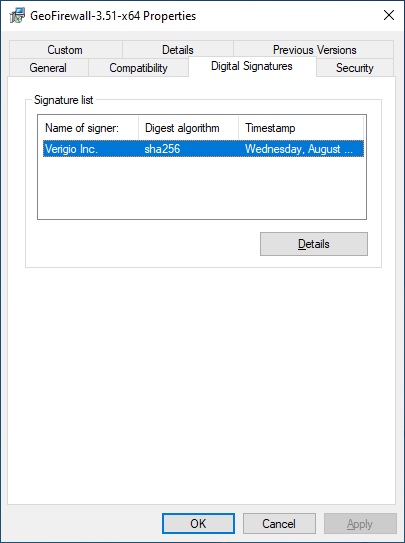
- Select the digital signature from the list and click the Details button.
- The new window will show the status and details of the digital signature. The signer
information name should show the company name "Verigio Inc.," and the top of the
General tab should state, "This digital signature is OK".
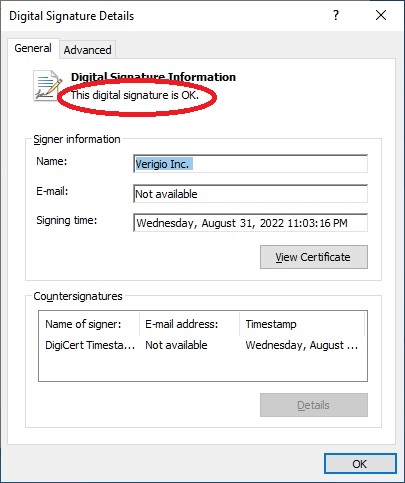
If the phrase "This digital signature is OK" is not shown, the certification path
needs to be examined. To do this, click the "View Certificate" button, then select
the "Certification Path" tab as shown below.
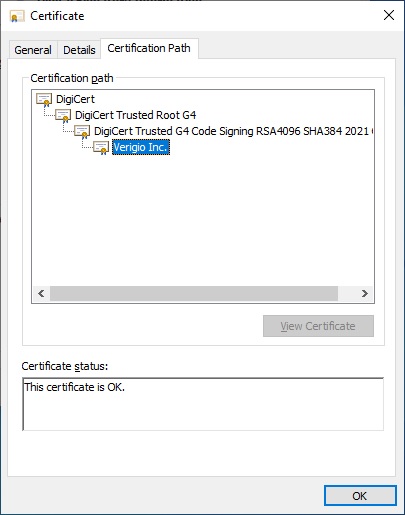 If one of the digital certificates in the path has a red cross mark, it means that the
certificate is untrusted or missing on the system. Most often on older systems, the top
node in the certification path will have a red cross mark. This condition indicates
out-of-date root certificates and will require launching Windows Update to update
them.
If one of the digital certificates in the path has a red cross mark, it means that the
certificate is untrusted or missing on the system. Most often on older systems, the top
node in the certification path will have a red cross mark. This condition indicates
out-of-date root certificates and will require launching Windows Update to update
them.
If any node other than the top one in the certification path has a red cross mark, it is
likely that the certification authority is explicitly distrusted by the system's settings.
Please contact your administrator to update these settings.
Sometimes, older standalone systems do not have internet access. These are most often
testing-related systems. Do not perform this on production systems, as it may
compromise their security! The certificates can be installed manually with the
following steps:
- Select the certificate from the certificate path.
- Click the "View Certificate" button.
- In the new Certificate window, on the General tab, click the
"Install Certificate..." button.
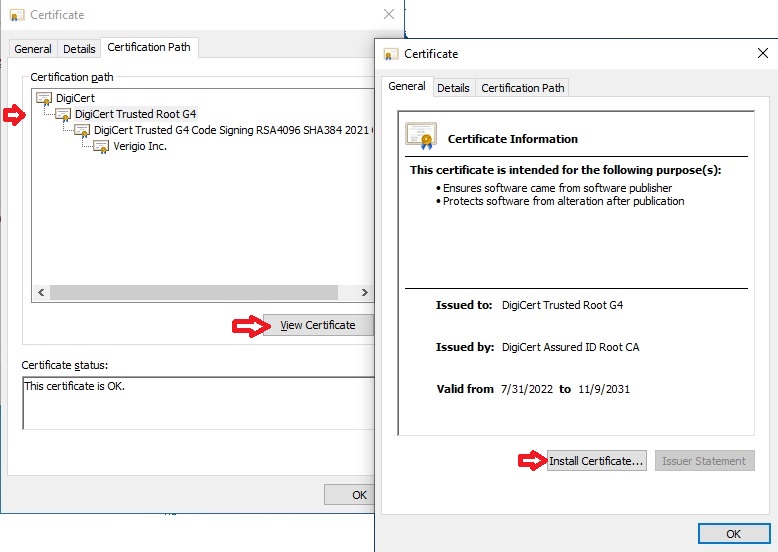
- For the "Store Location" select "Local Machine".
- Close all property windows for the file. Then, open the Properties window from
the context menu again. In the Properties window, on the "Digital Signature"
tab, click "Details". Then, on the General tab of the new window, the phrase
"This digital signature is OK" should appear.
If the above steps did not help to resolve the digital signature-related issues, please
contact our technical support.
Last updated: Oct 16, 2025.

 Shopping Cart

 Multi Port Forwarder
 DNS Proxywall
 Geo Firewall
 Geo Router
 Virtual Network Hub